
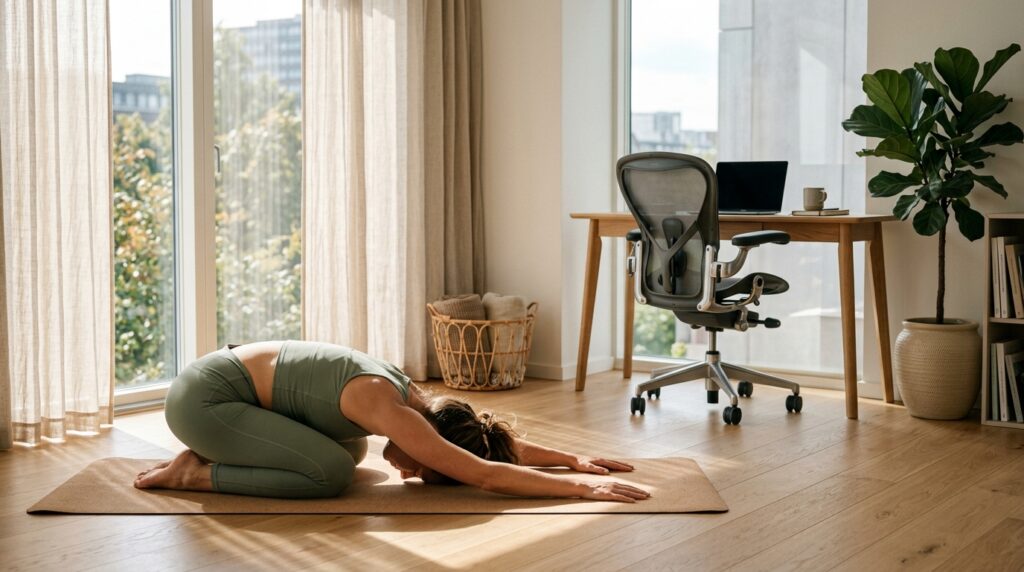
If you spend 7 to 9 hours a day seated at an office desk or commuting, chances are your morning begins with an all-too-familiar sensation: a tight, aching lower back that makes simply bending over to tie your shoes feel like an uphill battle.
Many assume this morning tightness is an inevitable part of aging or a flaw in their mattress. In reality, for most sedentary adults, morning lower back discomfort is the direct physiological result of what movement specialists call the “Desk-to-Bed Tension Loop.”

1. The “Desk-to-Bed” Loop: Why Sitting All Day Triggers Morning Aches
⬇
[ Evening Inactivity ] ➔ Lumbar Spine Absorbs Pelvic Tilting Strain
⬇
[ 8 Hours Sleeping ] ➔ Spinal Discs Naturally Hydrate & Swell Overnight
⬇
[ 6:00 AM Wake Up ] ➔ Swollen Discs + Tight Anterior Muscles = Acute Morning Stiffness!
A. Hip Flexor Shortening & Glute Amnesia: Sustained sitting keeps your hips flexed at 90 degrees for hours. The Psoas major muscles progressively shorten. When you stand up, these tight hip flexors pull your pelvis into an anterior pelvic tilt, jamming the lumbar facet joints together and straining back muscles.
B. Overnight Intervertebral Disc Rehydration: During sleep, gravity ceases to compress your spine, allowing your spinal discs to rehydrate like sponges. By morning, your discs are at maximum volume, making the surrounding spinal ligaments naturally tighter. Sudden, cold bending right out of bed creates peak disc pressure.
2. The 5-Minute Morning Bed Spine Reset Routine
Perform these gentle restorative movements right in bed or on a comfortable yoga mat within 15 minutes of waking up. Move smoothly, breathe deeply, and never force through sharp pain:
- Minute 1: Supine Pelvic Clocks — Lie flat on your back with knees bent and feet flat. Gently rock your pelvis, alternating between flattening your lower back into the mattress and gently arching it. Restores synovial fluid circulation with zero gravitational load.
- Minute 2: Gentle Quadruped Cat-Cow — Transition to hands and knees. Inhale as you gently tilt your pelvis and look forward; exhale as you slowly round your spine upward. Restores natural vertebral segmentation.
- Minute 3: Glute Bridge Activation — Lie on your back, press through your heels, and squeeze your glutes at the top for 3 seconds. Activates dormant glute muscles, which neurologically triggers the tight front hip flexors to release via reciprocal inhibition.
- Minute 4: Controlled Bird-Dog — On hands and knees, extend opposite arm and leg while bracing your core abdominal wall. Builds active lumbar stabilization without compression.
- Minute 5: Wide Child’s Pose with Side Flank Reach — Open your knees wide, sit back toward your heels, and reach both arms 45 degrees to the right for 30 seconds, then repeat to the left to gently decompress lateral lumbar tissues.
Download The Free 7-Day Morning Spine Reset Guide
Get our complete illustrated PDF containing step-by-step daily mobility routines, printable workstation posture checklists, and 2-minute desk micro-breaks.
3. Why Gentle Tai Chi & Qigong Movements Help Women Relieve Morning Back Stiffness
For many women, waking up with a stiff lower back is not just about muscle tightness—it is often tied to overnight fluid stagnation in the spine, pelvic misalignment, and lingering nervous system stress. While aggressive stretching or heavy forward bends right out of bed can place excessive pressure on cold spinal discs, gentle Tai Chi and Qigong movements offer the ideal low-impact morning remedy.
Rooted in slow, fluid spiral mechanics, Tai Chi utilizes continuous weight transfers and rhythmic diaphragm breathing to gently mobilize the pelvic girdle, activate deep transverse abdominals, and stimulate synovial fluid circulation around the lumbar facet joints without compressive force.
🌸 3 Gentle Morning Tai Chi Exercises for Women (Zero Equipment)
You can perform these three graceful movements barefoot on a soft rug or yoga mat right after stepping out of bed:
- 1. Wave Hands Like Clouds (Yun Shou — Torso Decompression): Stand with soft knees, hip-width apart. Let your arms float naturally at chest height as you slowly rotate your torso from left to right like passing clouds. This gentle horizontal rotation releases muscular guarding across the Quadratus Lumborum (QL) and restores lumbar vertebral fluidity.
- 2. Parting the Wild Horse’s Mane (Pelvic & Hip Mobility): Step gently forward with one foot, shifting 70% of your weight forward with an open chest, then smoothly glide your weight back into your rear heel. This rhythmic weight transfer gently lengthens contracted psoas and hip flexor muscles while waking up stabilizing gluteal muscles.
- 3. Supporting Heaven & Calming the Qi (Spine Lengthening): Inhale deeply as you raise both palms upward toward the sky, gently elongating the entire axial spine from tailbone to crown. Exhale slowly as your palms float downward, releasing stored tension in the neck, mid-back, and sacrum.
💡 Practical Daily Tip for Women: Spend just 3 to 5 minutes flowing through these gentle Tai Chi sequences before your morning coffee or seated commute. The combination of slow movement and extended exhalations down-regulates cortisol, helping your back muscles relax out of protective tension naturally.
4. Top 5 Supportive Ergonomic Tools for Daily Spine Protection
While movement restores mobility, maintaining proper spinal alignment during work and sleep prevents daily re-aggravation:

1. High-Density Memory Foam Lumbar Support Cushion
Office Chair EssentialStandard office chairs allow the pelvis to sag into posterior tilt, creating sustained lumbar strain. An ergonomically contoured cushion reinforces the natural lordotic spinal curve throughout long work hours.
Check Current Price & Reviews →2. Daily Acupressure Mat & Cervical Neck Pillow Set
Evening DecompressionStimulates thousands of sensory nerve endings across your back, triggering immediate localized blood flow and endorphin release to soothe muscular tightness before bed.
View Acupressure Sets →3. Non-Slip Fabric Loop Resistance Bands
Glute & Core RehabDurable fabric bands reactivate dormant gluteus medius muscles during glute bridges and lateral steps, relieving compensatory loading on the lower lumbar spine.
Explore Resistance Bands →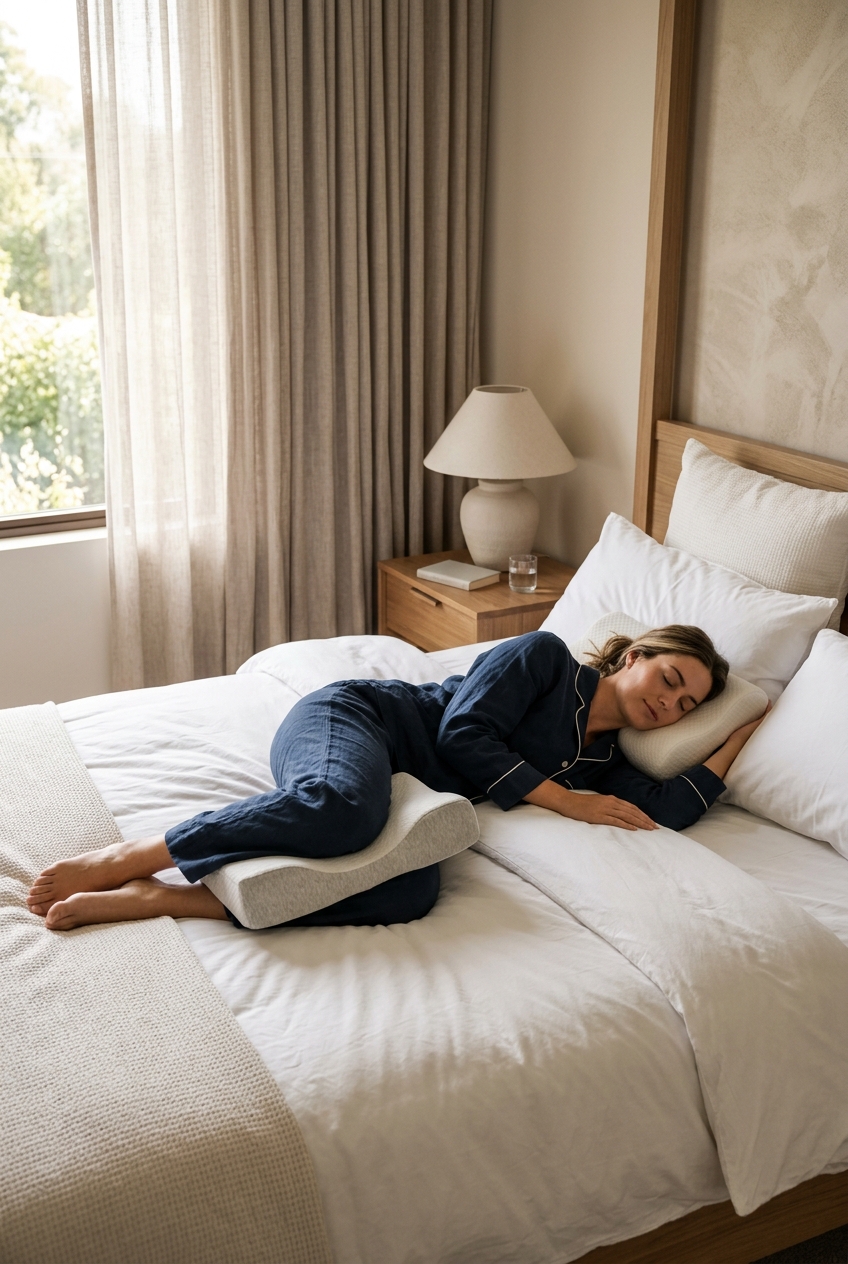
4. Orthopedic Contoured Knee Pillow for Side Sleepers
Nighttime AlignmentPrevents your upper leg from collapsing forward during side sleeping, eliminating 7 to 8 hours of sustained rotational twisting on your lower lumbar discs and sacroiliac joints.
Check Knee Support Pillows →5. Dual-Temperature Lumbar Gel Compression Wrap
Targeted TherapyMicrowaveable and freezable with adjustable ergonomic straps. Apply gentle soothing heat before your morning stretches or cooling compression after prolonged sitting.
Find Adjustable Gel Wraps →Medical Disclaimer: This article and the downloadable 7-Day Guide are designed for general wellness, mobility education, and postural awareness. They do not replace formal physical therapy, medical diagnosis, or personalized rehabilitation. If you suffer from severe or neurological symptoms, seek prompt medical care.
Affiliate Disclosure: Some of the links in this article may be affiliate links. If you purchase through these links, we may earn a small commission at no additional cost to you.